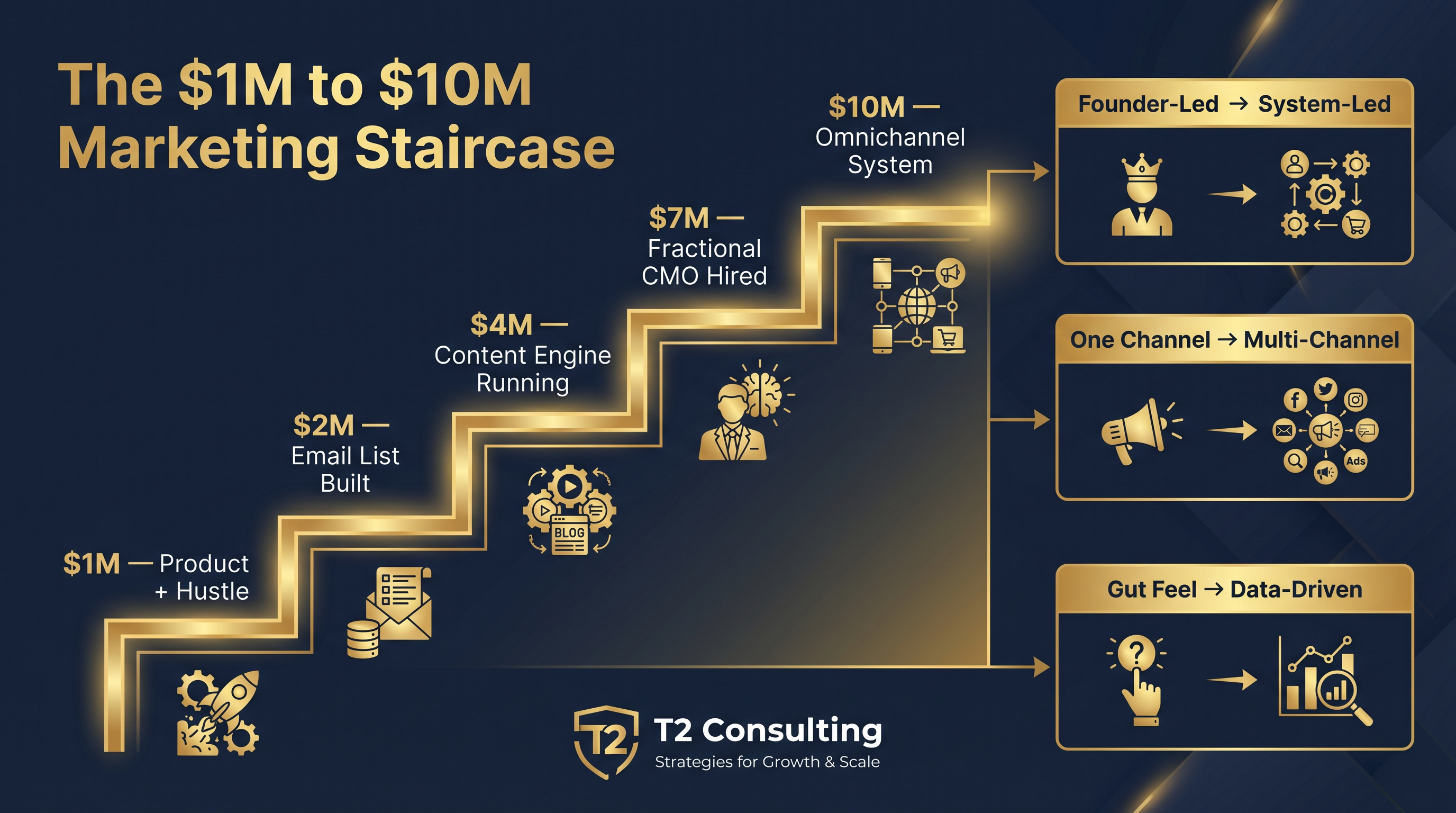
There is a specific kind of frustration that comes with running a $1M to $3M business. You've proven the concept. You have real customers, real revenue, and real proof that what you're doing works. But no matter what you try — more ads, more hires, more hustle — the number won't move. You're stuck.
This plateau is so common it has a name in growth consulting circles: the first-million trap. And the reason so many businesses get caught in it has nothing to do with the quality of the product, the work ethic of the founder, or the size of the market. It has everything to do with the fact that the strategies that work to build a $1M business are fundamentally different from the strategies required to build a $5M business.
Why the $1M to $5M Jump Is the Hardest in Business
Most business advice is written for one of two audiences: people just starting out, or people running large enterprises. The $1M to $5M stage gets almost no attention, which is ironic because it is the stage where the most businesses fail to advance.
The reason this stage is uniquely difficult comes down to three structural problems: the founder is still the system, the business has no repeatable growth engine, and the team is built for execution rather than scale.
The 6-Lever Framework for $1M to $5M Growth
Over the course of building and scaling multiple businesses, we developed a diagnostic framework called the Breakthrough GROWTH Method — a six-lever system that identifies exactly where a business's growth is constrained and what to do about it.
Lever 1: Generate Awareness (G)
At $1M, most businesses have awareness within a narrow circle. To get to $5M, you need to systematically expand that circle — not by spending more on advertising, but by building the brand signals that make prospects come to you before they ever see a sales message. For product companies, this typically means a combination of retail channel expansion, earned media, and content that establishes category authority.
Lever 2: Revenue Optimization (R)
Most $1M businesses have significant revenue leakage — money that is available but not being captured. This shows up in conversion rate, average order value, and pricing. Revenue optimization is often the fastest lever to pull because it doesn't require new customers — it requires getting more value from the customers and prospects you already have. A 20% improvement in conversion rate has the same revenue impact as a 20% increase in traffic, but typically costs a fraction as much to achieve.
Lever 3: Operational Efficiency (O)
Operational efficiency is not about cutting costs. It is about building the infrastructure that allows revenue to grow without a proportional increase in headcount or complexity. The key question: if your revenue doubled tomorrow, would your operations handle it without breaking?
Lever 4: Win the Right Customers (W)
One of the most counterintuitive insights from scaling multiple businesses is that not all revenue is equal. Some customers are profitable, refer others, and stay for years. Others are high-maintenance, low-margin, and churn quickly. At $5M, you need to be selective — and you need a system for finding and converting your best customers while filtering out the ones who will drain your resources.
Lever 5: Technology & Systems (T)
The businesses that successfully scale from $1M to $5M are almost always the ones that invest in systems before they need them. For most businesses, the gap shows up in CRM, marketing automation, and data and analytics. Without a CRM, you don't know where your pipeline is. Without marketing automation, you're manually doing things that should happen automatically. Without data, you're making decisions based on intuition rather than evidence.
Lever 6: Harvest Referrals & Retention (H)
The most expensive customer you will ever acquire is a new one. The cheapest is a referral from a satisfied existing customer. Yet most $1M businesses have no systematic approach to generating referrals or maximizing customer lifetime value. A structured referral program and a customer success process can add 20–40% to revenue without any increase in customer acquisition spend.
The 90-Day Sprint: How to Actually Execute
The approach we use with every T2 Consulting client is a 90-day sprint structure:
Days 1–30: Diagnose and prioritize. Run a full CROWTH Audit to score the business across all six levers. Identify the primary constraint. Build a 90-day action plan focused exclusively on that constraint.
Days 31–60: Execute the highest-impact interventions. Implement the two or three specific changes that will move the primary constraint metric most quickly. Measure weekly. Adjust based on data.
Days 61–90: Systematize and hand off. Document what's working, build it into repeatable processes, and train the team to own it. Begin diagnosing the next constraint.
What the $5M Business Looks Like
When a $1M to $3M business successfully makes the jump to $5M, the difference is visible in the structure of the business, not just the revenue number. The $5M business has a repeatable customer acquisition system that works without the founder's direct involvement. It has a team with clear roles and accountabilities. It has data that tells leadership what's working and what isn't. And it has a brand with enough authority that customers seek it out rather than needing to be found.
Where to Start
If you're reading this and recognizing your business in the description of the $1M trap, the first step is diagnosis — not action. Before you invest in more marketing, hire more people, or launch more products, you need to know which of the six levers is your primary constraint.
The fastest way to get that answer is the T2 Consulting GROWTH Scorecard — a free, 5-minute assessment that scores your business across all six levers and delivers a personalized action plan to your inbox.
Take the free GROWTH Scorecard at t2consulting.co/free-audit.